
Prices, opening hours, “do you have it in size M?”, “where’s my order?”. In most businesses, a big share of WhatsApp messages is the same question, asked by different people, all day long. While someone on the team answers them one by one, others are left waiting, and some of those customers give up before getting a reply.
A virtual assistant for businesses exists to solve that bottleneck. In this guide, you’ll see what it does in practice, with examples by type of business, what changed in WhatsApp’s rules, what it shouldn’t do and how to set it up without losing customers along the way.
What a virtual assistant for businesses is
A virtual assistant for businesses is a program that talks to customers on behalf of the company, on channels like WhatsApp, the website and Instagram. It understands the question, checks the business information and replies, and hands over to a person when the topic calls for human service. See a complete example, with flow, deliverables and timeline, in the WhatsApp AI customer service use case.
The difference from a personal assistant, like Alexa or Google Assistant, is the focus: those help one person in their daily life, while a business assistant knows a single business: its services, prices, calendar, stock and service rules.
Virtual assistant, chatbot and AI agent: what’s the difference
The three names get mixed up, but they point to different levels. A classic chatbot follows a script of buttons and canned replies. A virtual assistant with AI, on the other hand, understands the question the way the customer writes it and replies based on the company’s information.
Finally, an AI agent goes beyond conversation, because it carries out tasks on its own, such as opening a ticket or updating a customer record. In practice, many projects start as an assistant and gradually gain agent actions.
What a virtual assistant does day to day
An assistant is worth what it solves in the operation, not the technology behind it. That’s why the examples below show three different businesses. The conversations are illustrative and show how the assistant works, not a real client’s service.
Salons and clinics: scheduling and confirmation
In a salon with five professionals, each one has their own services and hours. Without an assistant, someone has to check each professional’s calendar before answering every booking request.
With the assistant connected to the calendar, the conversation looks like this:
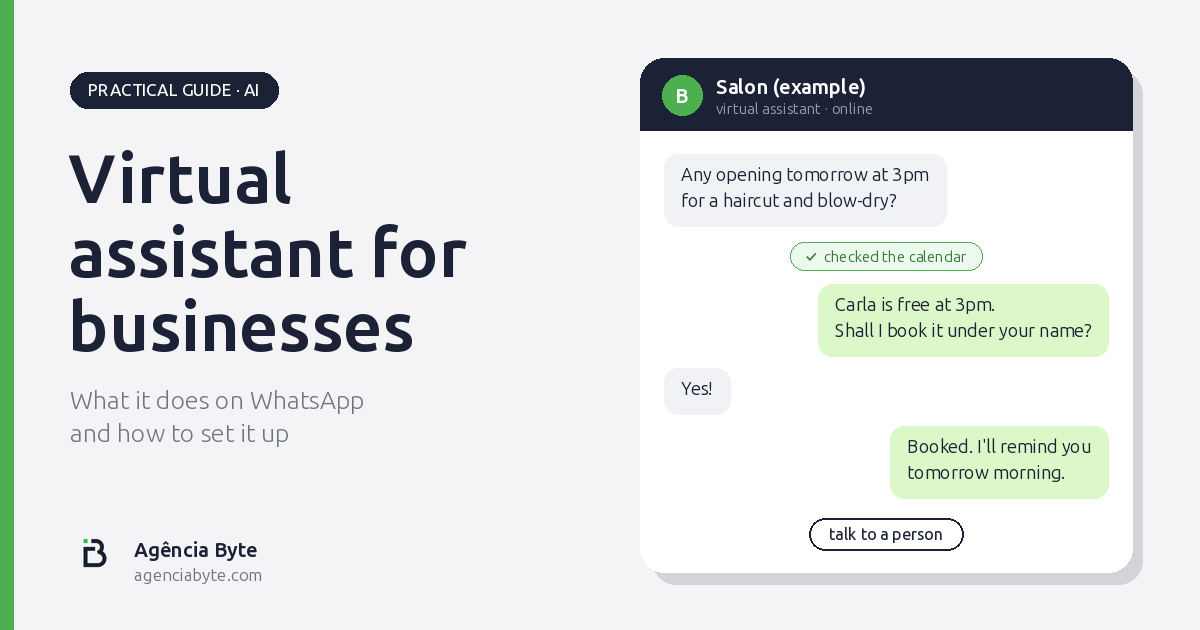
- Customer: Any opening tomorrow at 3pm for a haircut and blow-dry?
- Assistant: Tomorrow at 3pm Carla is free for a haircut and blow-dry. Shall I book it under your name?
- Customer: Yes.
- Assistant: Done, it’s booked. I’ll remind you tomorrow morning.
On top of that, the reminder the day before cuts down no-shows, which tend to be one of the biggest losses for this kind of business.
Retail stores: price, size and stock
In a clothing store, most messages ask about price, size and color. And that volume grows a lot around dates like Black Friday and Christmas, exactly when the team is busy at the counter.
In this case, the assistant checks the stock and answers right away whether the item is available in the requested size. When it isn’t, it can take down the contact and let the customer know when the product arrives, turning a “no” into a future sale.
Carriers and distributors: order status
Likewise, in logistics companies, the most repeated question is “where is my delivery?”. An assistant connected to the tracking system replies with the status using the order number or the company’s tax ID, without anyone having to open the system and copy the information.
Virtual assistants on WhatsApp: what changed in the rules
WhatsApp is the most used channel for this kind of service in Brazil and across Latin America, and Meta changed the rules for AI on the platform. The WhatsApp Business Platform Terms, in section 4.7, prohibit artificial intelligence providers from using the platform to offer general-purpose AI assistants, like the ones that answer any question on any topic. The change applies to all accounts since January 15, 2026.
On the other hand, a company’s assistant is still allowed, because the AI there supports that business’s customer service and isn’t the product itself. In practice, this means the assistant should only talk about your business. If it answers any question in the world, it stops being customer service and becomes the kind of use Meta wants to prevent.
What a virtual assistant shouldn’t do
A poorly configured assistant drives customers away faster than a slow reply. That’s why some limits need to be set from day one.
First, it shouldn’t be pushy. Sending several messages in a row asking for a meeting or chasing a reply makes the customer pull away, even when they were interested. In Agência Byte’s experience with WhatsApp customer service, a single clear question gets more replies than a string of follow-ups.
Next, it shouldn’t promise what isn’t in the rules. A final price, delivery time and discount can only come from the assistant if those conditions are written down and connected to a system. Otherwise, it should say it will confirm with the team.
It also shouldn’t hide that it’s automated. Saying right at the start that the customer is talking to an assistant, and that they can ask for a person whenever they want, avoids frustration and builds trust.
Finally, it shouldn’t try to solve everything. Complaints, negotiations and out-of-the-ordinary cases go to a person, with the conversation history attached, so the customer doesn’t have to repeat what they already said.
How to set up a virtual assistant in your business
Setting it up starts with the problem, not the tool. The path below helps you put the assistant live without risking your relationship with customers.
Start with the most repeated questions
First, read the conversations from the last few weeks and list the ten most frequent questions. They usually account for most of the volume, and that’s where the assistant should start.
Connect it to the systems that hold the answer
An assistant that only reads a fixed text becomes an FAQ list. The real gain shows up when it checks the calendar, the stock or the order during the conversation, and that depends on system integration.
When Agência Byte builds an AI automation on WhatsApp, the first step is precisely to check which systems hold the answer and how the assistant will query them.
Define when to hand over to a person
Before turning the assistant on, write down the handover rules. For example, it hands over to the team when the customer asks, when the topic is a complaint or when it can’t find the answer in the company’s information. This way, no customer gets stuck in a conversation that goes nowhere.
Review the conversations in the first few weeks
In the first few weeks, someone on the team should read a sample of the conversations every day. That lets you fix wrong answers, add questions you hadn’t planned for and adjust the tone. After that, once the answers settle, the review can be weekly.
How much a virtual assistant costs and what makes the price vary
The cost depends on the scenario, so any number given without knowing the operation is a guess. Even so, a few factors explain most of the difference between quotes.
The first is the number of integrations, since an assistant that only answers frequent questions is much simpler than one that checks the calendar, stock and orders. Next comes message volume, because Meta charges for sending some messages on the official API and the AI model also has a usage cost. Finally, the quality of the company’s information matters, because outdated prices, rules and services require organizing work before any automation.
So ask for a quote that separates setup, monthly usage cost and maintenance. That way, you compare what each vendor delivers, not just the final price.
Conclusion
In short, a virtual assistant for businesses answers the questions that keep repeating, checks the systems to give the right information and passes to the team what needs a person. On WhatsApp, it’s still allowed as long as it talks about your business, and it works best with clear limits on what it shouldn’t do.
So, before choosing a tool, list the most frequent questions you get today and see which systems hold the answer. That map is where the assistant starts to make a difference.
Want a virtual assistant that answers your customers with your company’s information? Book a 30-minute call with Agência Byte so we can understand your customer service and design the flow.